How much does land clearing cost per acre in California?
Published 2026 guides put land clearing at about $1,200 to $2,500 per acre for light brush and $3,500 to $6,000 or more for heavy timber (OWNR OPS, 2026). California runs higher. The same guide’s West region lands at $1,800 to $3,500 light and $5,000 to $8,000 or more heavy.
Those are published market figures, not our price list. Method and density move the number further than acreage does, so read the ranges by job type before you read them by size. Redding and Shasta County then add their own line items on top of hand-crew land clearing.
What do published guides charge per acre?
Every major guide publishes a per-acre band, and they disagree by thousands. That is because they price different jobs under one name. Cutting vegetation, mulching woody stems, and grubbing stumps out of the ground are three different scopes. The table sorts the published 2026 numbers by what the crew is actually doing.
| Scope or method | Published range | Source |
|---|---|---|
| Light brush and grass, per acre | $1,200 to $2,500 | OWNR OPS, 2026 |
| Medium vegetation, per acre | $2,000 to $3,500 | OWNR OPS, 2026 |
| Heavy timber, per acre | $3,500 to $6,000 and up | OWNR OPS, 2026 |
| Manual clearing on foot, per acre | $3,000 to $8,000 | OWNR OPS, 2026 |
| Forestry mulching, per acre | $1,800 to $4,000 | OWNR OPS, 2026 |
| Excavator clearing, per acre | $2,500 to $6,000 | OWNR OPS, 2026 |
| Land clearing, per acre | $1,395 to $6,167 | Angi, 2026 |
| Crew and equipment, per hour | $110 to $250 | Fixr and Angi |
| Grinding out a stump, each | $150 to $500 | OWNR OPS, 2026 |
| Full stump extraction, each | $250 to $800 | OWNR OPS, 2026 |
| Rough grading, per acre | $1,000 to $3,000 | OWNR OPS, 2026 |
| Debris hauling, per acre | $500 to $2,000 | OWNR OPS, 2026 |
Read the bottom of that table carefully. Stumps, grading and debris are separate line items, and a guide that folds them into one per-acre number reads high for a job that only takes the growth off. Brush-only work prices lower again, and those ranges sit in what brush clearing costs per acre.
What does it cost by lot size?
Per-acre math breaks down on small parcels. Published quarter-acre figures run $500 to $1,000 for light brush and $1,500 to $3,000 for heavy timber (OWNR OPS, 2026). A half acre runs $800 to $1,500 light and $2,500 to $4,500 heavy. Five acres of light brush is published at $7,500 to $12,500.
Fixr runs a flatter ladder across all densities: $125 to $1,250 for a quarter acre, $250 to $2,500 for a half, and $500 to $5,000 for a full acre.
Mobilization is published at $300 to $1,500 per job, and it lands on a quarter acre the same way it lands on five. At the other end, the same guide reports volume discounts of 10 to 20 percent once a job passes 5 acres.
Why does California price above the national average?
Labor, workers compensation insurance and disposal. Trade guides describe the West Coast running 20 to 40 percent above national averages and name California among the most expensive clearing markets (OWNR OPS). The same publisher prices the Sacramento market at $2,200 to $6,000 per acre, a directional figure rather than a Redding quote.
No company publishes per-acre prices for Redding, and the closest published California market sits hours south on flatter ground. Insurance is part of the gap. We carry $1 million in general liability, and a certificate of insurance is available on request.
What do Redding and Shasta County add to the price?
Four local line items, and none of them show up in a national guide. A city clearing permit above one acre, $65 per tree over 6 inches across, no burning this season, and green waste tipping fees by the ton. On a wooded parcel inside the city those stack up quickly.
| Local factor | What it does to the price | Source |
|---|---|---|
| Clearing inside Redding | No city permit at 1 acre or less on a single site, permit required above that even with no dirt moved | Per the city’s permit handout |
| Removing a tree over 6 inches across | $65 per tree, vacant land included | Per the city’s permit handout |
| Burning the cut material | Off the table. Burn permits in the Shasta County State Responsibility Area have been suspended since June 15, 2026 | burnpermit.fire.ca.gov |
| Tipping fees | Green waste $34.75 per ton, mixed waste $112 to $114.50 per ton | Redding Transfer Station, rates effective July 1, 2025 |
| Stumps, dirt and concrete | Refused at the transfer station, taken at West Central Landfill in Igo | Redding Transfer Station rates |
| Unincorporated county parcels | Weeds and grasses held to 4 inches, stumps to 8 inches | Shasta County Code Chapter 8.10 |
The burn suspension is the one that changes budgets this year. Piling and burning is published at a fraction of haul-off cost, and it is not available right now, so cut material gets staged on site or loaded out by the trailer-load. The status sits in our Shasta County burn permit guide.
The permit line is cheaper to check than to fix. We flag anything permit shaped before it is cut, and the full map is in which clearing jobs need a permit.
Which of those line items are our work?
The vegetation. Our crew cuts brush, saplings, blackberry and cured grass to ground level with brush cutters and backpack trimmers, then rakes and stages the material or loads it out by the trailer-load. Stumps stay in the ground unless they can be cut flush. Grubbing, grading and tree removal belong to other trades.
That split matters for a build budget. Clearing to pour a pad means two contracts: the growth, then the stumps, dirt and pad. The stump and grading rows above are where the second number comes from. Clearing for a sale, for access or for fire safety is usually the vegetation line alone.
When the clearing runs right up to a house, it becomes clearing to the defensible space standard instead, and the scope is measured in feet from the structure rather than in acres.
When is a hand crew the right hire, and when is a machine?
Ground decides it. Under oak canopy, on slopes, on rock, near septic lines and tight against structures, a crew on foot cuts what a machine cannot reach. On open acreage with dense woody stems and stumps coming out, a machine outfit is the right hire, and the published mulching rate shows why.
Machine production is published: 0.5 to 2 acres a day for forestry mulching and 0.5 to 1.5 for an excavator (OWNR OPS, 2026). Nobody publishes a rate for hand crew clearing, so we will not invent one. Your timeline comes out of the walk-through. The method comparison sits in how hand crews and machines compare on the same ground.
What should a land clearing estimate say?
Acreage and linear footage measured on the ground, the growth described by density, what happens to the cut material, and a price that holds unless the scope changes. Anything a national calculator gives you is a starting band. The number that matters comes off your parcel, not off a chart.
We are a veteran-owned company, and every job carries before-and-after photos, so a broker or a property manager gets a written record for the file. The second half of the payment is due when the work is done to your satisfaction.
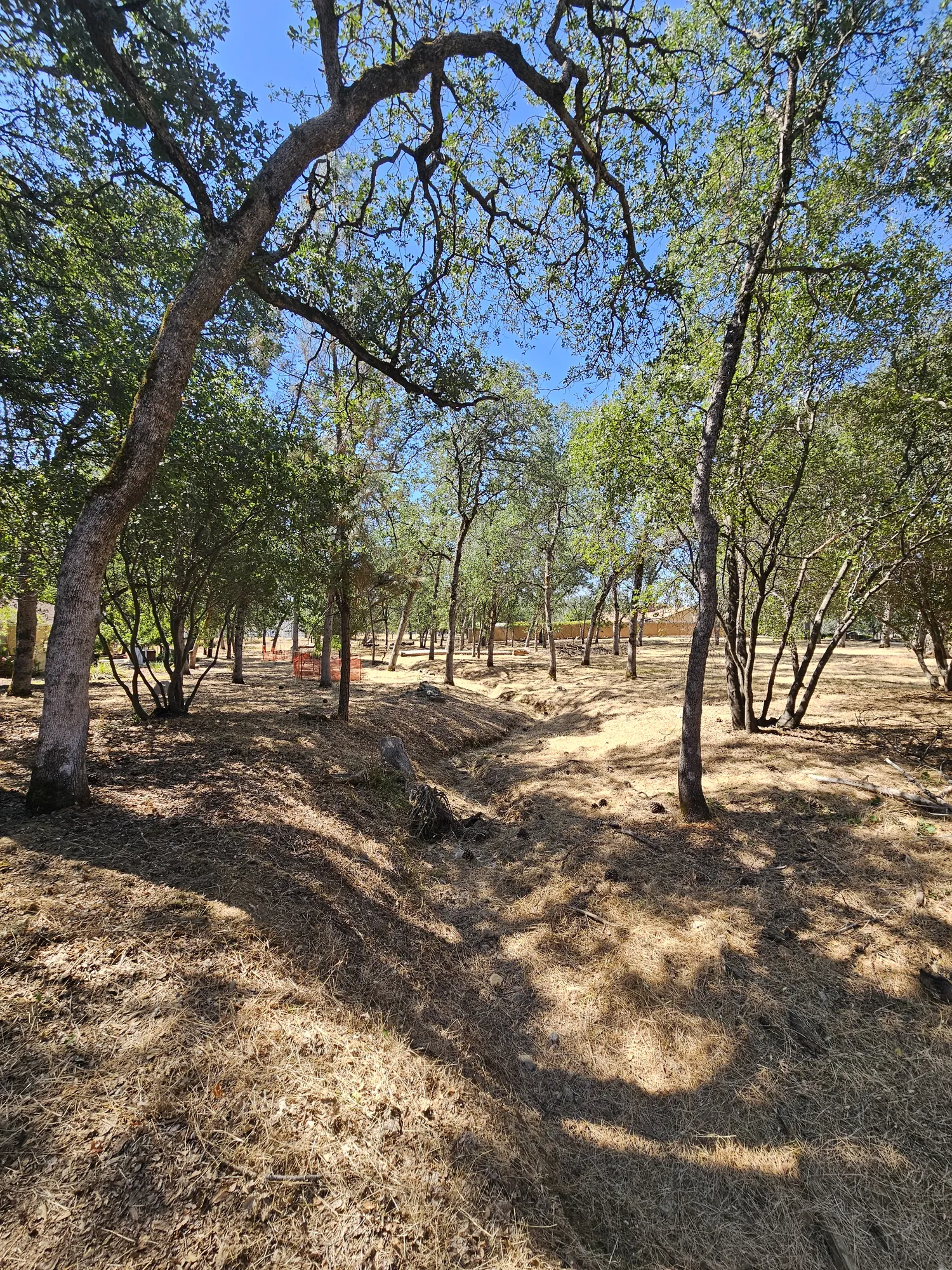
Around Palo Cedro, Anderson, Bella Vista and Cottonwood, that ground is oak woodland and valley floor, which is what our land clearing work is built for.
Call or text (530) 238-5077 for a free walk-through and a written estimate anywhere within 50 miles of Redding. The walk-through is usually within days.