
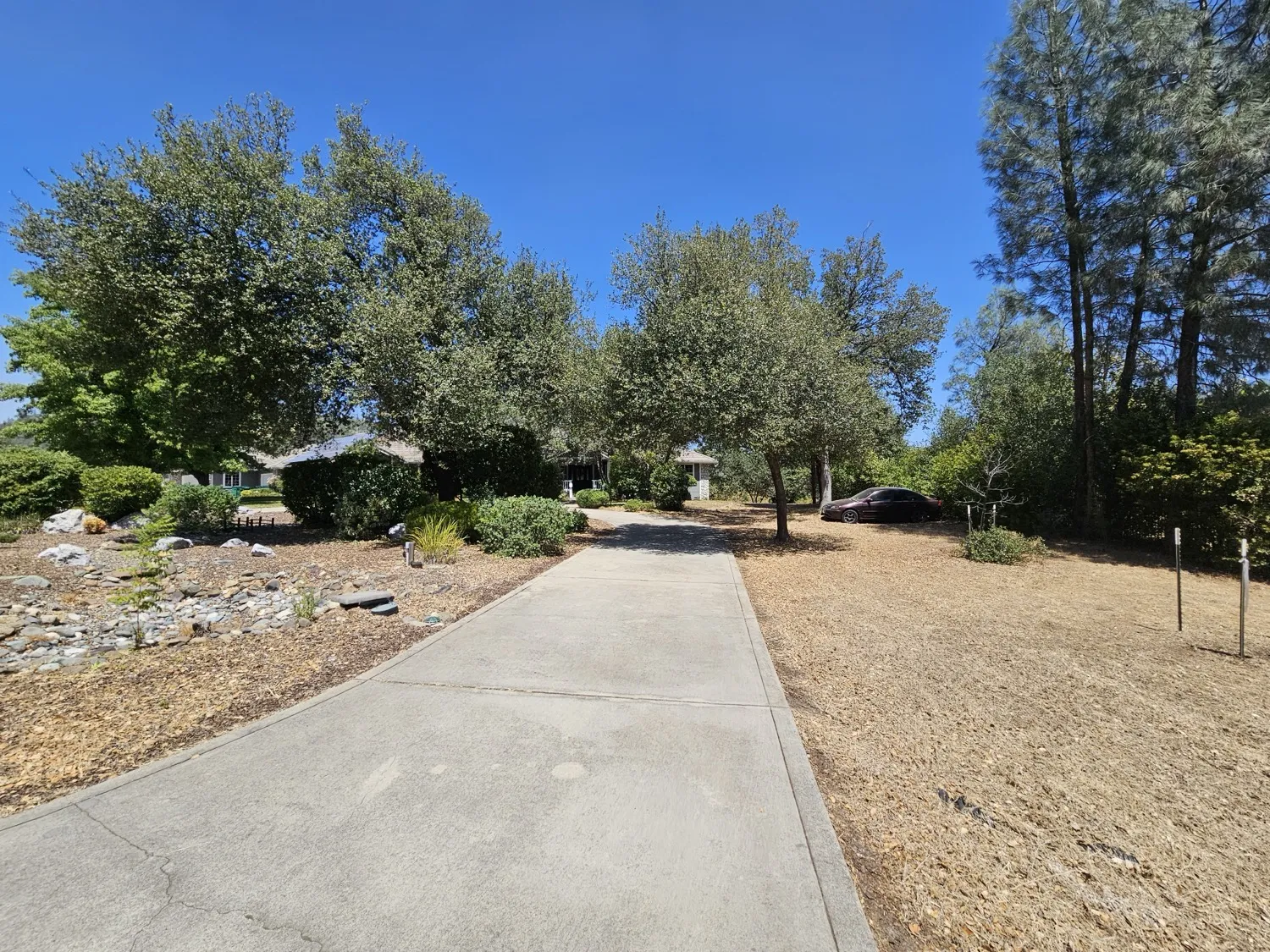
What happens in a California defensible space inspection?
An inspector measures the ground around your home against Public Resources Code 4291. They check the first 30 feet hardest: dead material, roof and gutter debris, grass height, ladder fuels, firewood and clearance around propane tanks. Findings go on a written notice with a compliance date, and a reinspection follows.
Who does that measuring depends on where your parcel sits, and around Redding the rulebook changes with the property line. If you would rather fix the ground before anyone writes it up, our defensible space clearing to the 100-foot standard is built to what inspectors look for.
Which agency inspects your property?
Three agencies work this area, and the rule they enforce depends on your address. Most of unincorporated Shasta County is State Responsibility Area, inspected by CAL FIRE’s Shasta-Trinity Unit. The county Fire Warden enforces the county ordinance on that same ground. Redding city limits belong to the city fire department.
| Agency | Where it applies | Rule enforced |
|---|---|---|
| CAL FIRE Shasta-Trinity Unit | State Responsibility Area, most of the unincorporated county | PRC 4291, roughly 3-year neighborhood rotation |
| Shasta County Fire Warden | Unincorporated county parcels, improved or vacant | County Code Chapter 8.10, Ordinance SCC 2025-03 |
| Redding Fire Department | Redding city limits, Local Responsibility Area | Gov Code 51182 in very high hazard zones; complaints at (530) 225-4141 |
The unit works its rotation neighborhood by neighborhood through fire season, out of the office at 875 Cypress Ave in Redding, (530) 225-2418.
In the county both rulebooks apply. State law asks for 100 feet around structures. Chapter 8.10 reaches further: parcels of 2 acres or less get treated end to end, 2 to 10 acres need a 30-foot perimeter or a plan the Fire Warden approves, and adjacent parcels under one owner count as one. The zone-by-zone version of the state standard is in our guide to California’s defensible space requirements.
What does the inspector check, item by item?
Everything that could carry flame to the structure, working from the walls outward. The state’s Property Inspection Guide hands inspectors the measurements: 4 inches of grass, 3 inches of litter, 6 feet of limb height, 10 feet of bare soil around a propane tank. Dead material comes first.
These standards come from the 2023 CAL FIRE Office of the State Fire Marshal Property Inspection Guide, restating PRC 4291 and 14 CCR 1299.03.
| Inspection item | What passes | Zone |
|---|---|---|
| Dead and dying vegetation | Removed within 30 feet, roof and deck surfaces included | Zone 1, 0-30 ft |
| Roof and gutters | Free of leaves, needles and other flammable debris | Zone 1 |
| Under decks and stairs | Flammable material and vegetation cleared below and beside them | Zone 1 |
| Firewood piles | Outside 30 feet, 10 feet of clearance to bare mineral soil | Zone 2, 30-100 ft |
| Grass and weeds | Stubble no taller than 4 inches | Zone 2 |
| Surface litter | No deeper than 3 inches | Zone 2 |
| Tree limbs | Lowest branches 6 feet up; under 18 feet tall, lower third removed | Zone 2 |
| Shrubs under trees | Gap of 3 times the shrub height to the branch above | Zone 2 |
| Fuel separation | 4 feet on flat ground, up to 40 feet on steep ground | Zone 2 |
| Branches near the chimney | Cut back 10 feet from a chimney or stovepipe outlet | Zones 1 and 2 |
| Propane (LPG) tank | 10 feet of clearance to bare mineral soil in all directions | Zones 1 and 2 |
| Outbuildings under 120 sq ft | 10 feet of clearance to bare mineral soil | Zones 1 and 2 |
| Logs and stumps | Sound wood may stay if isolated from other fuel; punky wood comes out | Zones 1 and 2 |
| Chimney screen | Spark arresting screen, half-inch mesh minimum | Structure |
| Address number | Posted, reflectorized, visible from the road | Access |
| Driveway | 10-foot lane, 13 feet 6 inches of vertical clearance | Access |
The address and driveway rows come from the fire safe regulations under PRC 4290, not the 100-foot rule. Inspectors note them because an engine has to get in. On spacing, a clump of one plant type under 10 feet of foliage width counts as a single plant, so a thicket reads as one large fuel.
What happens if you fail?
The inspector writes the violations on a Notice of Defensible Space Inspection, the LE-100a form, and sets a time limit for the fix. You keep a copy with the inspector’s contact number. A reinspection follows. How long you get is set case by case, not statewide.
The guide tells inspectors to tighten that window as fire weather gets worse. A May notice reads differently than an August one, so ask for your date.
The county side can move faster. Under the ordinance, an abatement notice in unincorporated Shasta County can allow as few as five calendar days.
A first PRC 4291 violation is an infraction of $100 to $500. A second within five years runs $250 to $500. A third is a misdemeanor starting at $500, and the state can do the work and bill you. Proof of a fix can cut a first fine to $50. Clearing prices are in what defensible space clearing costs in Northern California.
How do you request an inspection?
You can ask for one instead of waiting for the rotation to reach your road. CAL FIRE takes requests through a public online defensible space request form and through the Shasta-Trinity Unit office at (530) 225-2418. Shasta County takes them through Stay Ready Shasta. No fee is published for the visit.
Sellers and listing agents can request one too. The state’s guide treats real estate inspections as their own category, tied to the disclosure law below.
What does selling a home in a fire hazard zone require?
Since July 1, 2021, Civil Code 1102.19 has required sellers in a high or very high fire hazard severity zone to give the buyer documentation that the property complies with PRC 4291 or the local vegetation ordinance. No documentation by the close of escrow means a written agreement instead.
In that agreement, the buyer takes on the job and has one year from the close of escrow to get compliance documented.
Where the local jurisdiction runs its own compliance process, documentation comes through it. Where there is none, the statute points to an inspection by a qualified entity obtained within six months before the sale. The state’s guide adds the paperwork test: the Fire Hardening and Defensible Space Disclosure applies to residential property of one to four units, where the seller completes a transfer disclosure statement.
For a listing on acreage around Palo Cedro, Bella Vista, Happy Valley or Shasta Lake, the clearing is easier to schedule before escrow than during it.
What changes when Zone 0 takes effect?
Zone 0 is the ember-resistant strip in the first 5 feet around a structure. The Board of Forestry adopted it on August 19, 2026. It is not in effect yet, and it takes effect in phases after administrative review. Existing homes get about 3 years for Phase 1 and 5 for Phase 2.
Phase 1 is housekeeping: firewood, dead leaves and branches, mulch and wood chips out of the first 5 feet, gutters clean, dead plants gone, trees trimmed. Phase 2 reaches the under-eave area, combustible gates, sheds and fencing. Grass inside Zone 0 gets mowed to 3 inches. What the rule bans is in our breakdown of the adopted Zone 0 standard.
Inspectors are not writing Zone 0 violations yet, but dead material and firewood against a wall already fail under Zone 1.
What should be done before the inspector comes?
Cut the grass down and take the dead material out, then open the ground next to anything that burns. The fails cluster where a machine cannot reach anyway: tight against the house, along fences, under decks, on the slope behind. That is hand work.
- Grass and weeds to 4 inches, end to end if you hold 2 acres or less in the county.
- Dead and dying material out of the first 30 feet, roof and gutters included.
- The first 5 feet cleared of anything that burns, which puts you ahead of Zone 0.
- Brush cut back off the driveway edge and the fence line.
- Firewood moved past 30 feet, bare soil around the pile.
- Vegetation cleared 10 feet around the propane tank and any outbuilding.
- Cut material raked into hand-stacked piles for the chipping program.
Our crew cuts brush, thicket, saplings and dry grass by hand, then details around structures, fences, tanks and keeper trees. Overhead limb work, tree removal, stump work and grading are other trades. Past 100 feet the job takes another name: fuel reduction on acreage beyond the buffer thins fuel so fire loses its ladder.
Two local programs are free. The Western Shasta Resource Conservation District runs a Defensible Space Readiness Program for qualifying low-income, elderly, disabled or veteran owners, at (530) 206-7506. The Shasta County Fire Safe Council chips hand-stacked piles at no charge. Funding is limited.
Documentation pays off past the inspection. The California FAIR Plan’s own materials show a 16.4% dwelling fire discount and a 13.8% commercial discount for qualifying mitigation, and many carriers ask to see vegetation work documented. We photograph every job before and after. More in wildfire mitigation discounts on California policies.
We are a veteran-owned company based in Redding with $1 million in general liability, and our hand-crew defensible space clearing works to the measurements above. The walk-through and written estimate are free, usually within days, and the scope goes in writing, down to what happens to the material we cut. Call or text (530) 238-5077 anywhere within 50 miles of Redding.